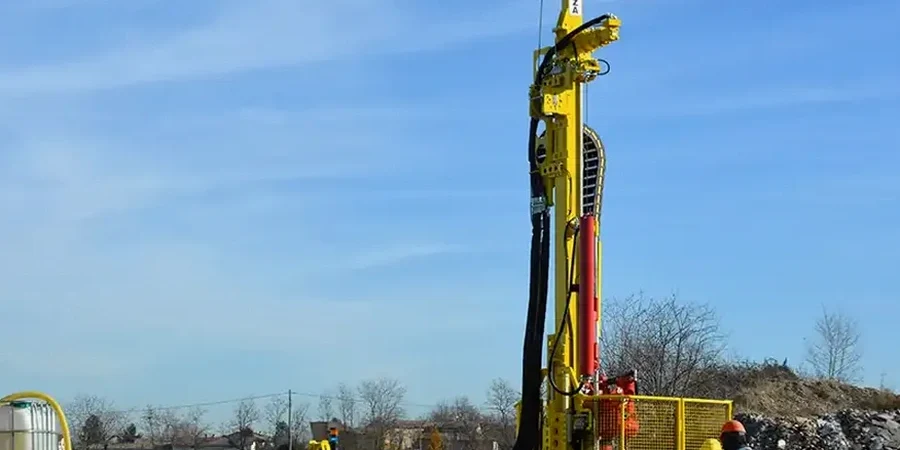
The Saguenay graben presents a unique geological setting where deep marine clay deposits—remnants of the post-glacial Laflamme Sea—interfinger with glacial tills and deltaic sands. These sensitive clays, particularly in the low-lying areas of Jonquière and Chicoutimi, exhibit a pronounced structure that can collapse under loading or remolding. Standard Penetration Testing remains the most practical method to quantify this risk: by driving a split-spoon sampler into the deposit, technicians record the N-value directly, providing an immediate index of density and consistency that correlates well with undrained shear strength in the local Champlain Sea-derived sediments. For sites near the Rivière Saguenay or its tributaries, where water tables often sit within 2 meters of grade, the SPT also captures groundwater behavior during drilling, a detail that synthetic modeling alone cannot replace.
SPT blow counts in Saguenay's sensitive clays demand careful interpretation—an N-value of 2 may indicate a deposit that loses 90% of its strength when disturbed.
Local geotechnical context
The temperature swing between Saguenay's January lows of -25°C and July highs of 25°C creates a freeze-thaw cycle that destabilizes shallow foundations when the underlying soil is frost-susceptible. Silt lenses within the Saint-Jean-Vianney sector, for example, can heave noticeably during winter unless the bearing stratum extends below the 2.1-meter frost penetration depth mandated by the Quebec Construction Code. A single-family home builder learned this the hard way in 2022 when differential movement cracked a newly poured slab—subsequent SPT borings revealed a 1.8-meter layer of frost-susceptible silt that the initial hand-auger survey had missed. The standard penetration test remains the most defensible line of evidence for insurers and municipal building officials: each blow count ties directly to a depth, a soil description, and a sampling interval, creating an auditable record that hand penetrometers cannot match. In Saguenay's seismic context—the 1988 magnitude 5.9 earthquake originated just 35 km south of the city—the NBCC 2020 classification of site class based on SPT N-values feeds directly into the structural engineer's seismic load calculations.
Regulatory framework
NBCC 2020 (National Building Code of Canada) – Seismic site classification via SPT N60, CSA A119.1 / BNQ 2501-135 – Standard penetration test procedure for Quebec, ASTM D1586-18 – Standard Test Method for Standard Penetration Test (SPT) and Split-Barrel Sampling of Soils, Quebec Construction Code, Chapter I, Building – Frost protection depth and bearing capacity requirements
Questions and answers
What does a standard SPT investigation cost for a residential lot in Saguenay?
For a typical single-family home lot requiring two boreholes to 8 meters depth, the SPT investigation ranges from CA$700 to CA$1,060. The final figure depends on access conditions, the need for winter drilling equipment, and whether groundwater monitoring wells are included. Commercial projects with deeper boreholes and more sampling intervals fall toward the upper end of that bracket.
How does the SPT help with Saguenay's sensitive clay problem?
The SPT provides a direct measurement of penetration resistance that, when combined with laboratory Atterberg limits and moisture content, reveals whether a clay deposit exhibits sensitive behavior. Very low N-values—often 1 or 2 blows per 30 cm—coupled with liquidity indices above 1.2 signal a material that can lose significant strength if disturbed during excavation or foundation loading. This triggers the design team to consider over-excavation, lime stabilization, or deeper bearing alternatives.
How many boreholes do I need, and to what depth?
For a residential structure under 600 square meters, two to three boreholes to a minimum of 8 meters or until competent till is encountered, whichever is deeper, satisfies most municipal requirements in Saguenay. Commercial projects typically require a grid spacing of 15 to 25 meters, with depths extending to 1.5 times the foundation width below the proposed bearing elevation. The exact layout follows the geotechnical site investigation guidelines in the Quebec Construction Code and is tailored to each parcel.