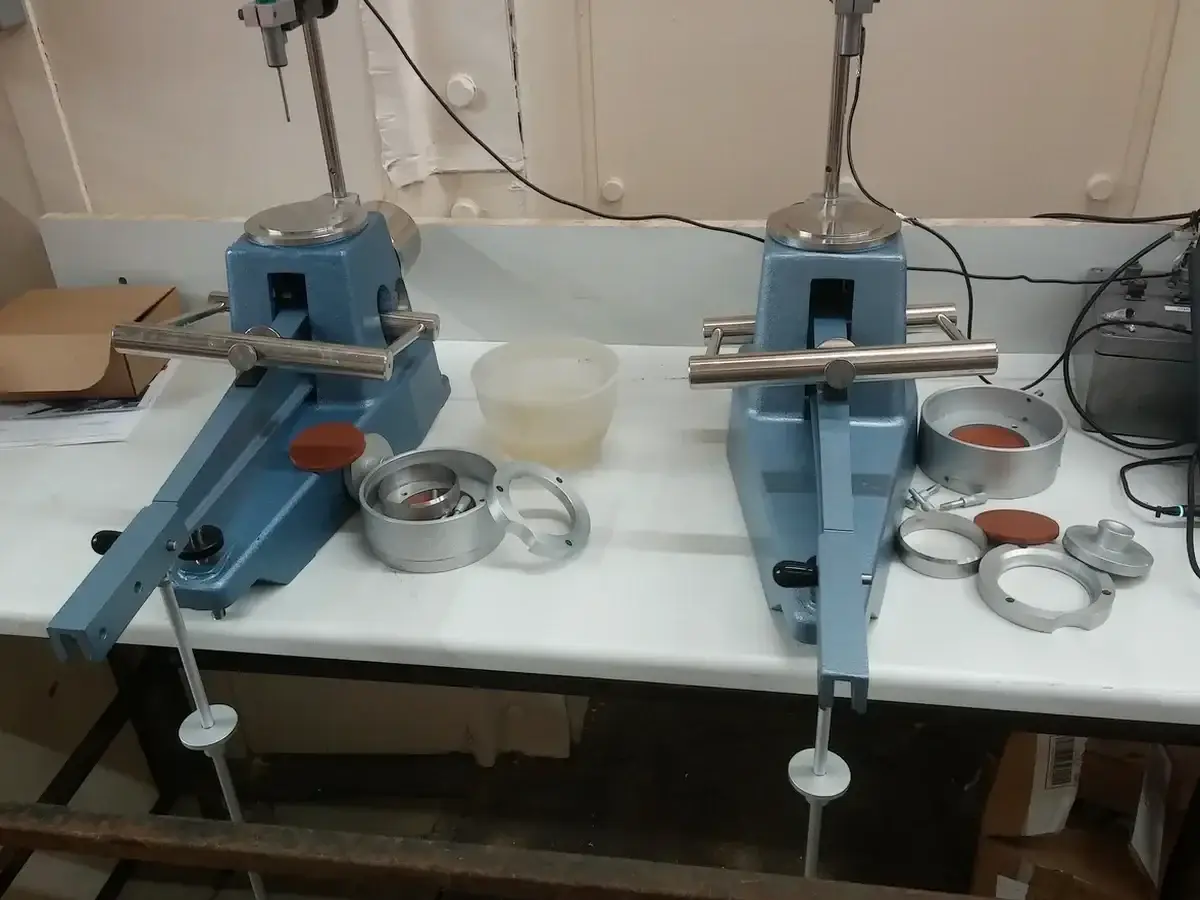
Geotechnical laboratory testing forms the analytical backbone of any construction or infrastructure project in Saguenay, providing the essential data engineers need to design safe, durable, and economical foundations. This category encompasses a wide range of physical and mechanical tests performed on soil and rock samples recovered from boreholes and test pits across the region. From determining basic index properties to simulating complex in-situ stress conditions, these procedures transform raw field samples into quantifiable engineering parameters. In a landscape shaped by glacial and post-glacial processes, understanding the precise behavior of local soils under load is not just a regulatory requirement, but a fundamental component of risk management for developers, municipalities, and civil engineering firms operating throughout the Saguenay–Lac-Saint-Jean area.
The unique Quaternary geology of Saguenay directly dictates the critical importance of specialized laboratory analyses. Much of the urbanized and developable land lies atop thick sequences of sensitive marine clays, notably the Laflamme Sea clays, deposited approximately 10,000 years ago. These silty clays are infamous for their meta-stable structure; they can lose significant shear strength when remolded or disturbed, a phenomenon directly assessed through tests like the Atterberg limits. Furthermore, the region’s stratigraphy often includes interbedded layers of glacial till, deltaic sands, and occasional gravel lenses, creating complex groundwater regimes and differential settlement potential. Accurate laboratory characterization is therefore the only reliable method to distinguish between a competent bearing stratum and a highly compressible or liquefiable layer concealed beneath a uniform surface appearance.
Adherence to national and provincial standards governs all laboratory procedures to ensure data consistency and legal defensibility. The primary framework is the Canadian Foundation Engineering Manual (CFEM) alongside standards published by the Bureau de normalisation du Québec (BNQ) and the Canadian Standards Association (CSA). For instance, CSA A23 series standards guide concrete and aggregate testing, while soil classification strictly follows the Unified Soil Classification System (USCS) as detailed in ASTM D2487, adopted within the BNQ 2501 suite. Crucially, for projects involving the province's transportation ministry, all laboratory work must conform to the *Recueil des méthodes d’essai LC* published by the Ministère des Transports et de la Mobilité durable (MTMD). This strict regulatory environment ensures that whether assessing a slope’s stability or a highway embankment’s compaction potential, the laboratory data withstands rigorous third-party review.
Virtually every significant development in Saguenay triggers the need for a comprehensive laboratory testing program. Major industrial expansions, such as those at the Rio Tinto aluminum smelters or the Port of Saguenay, demand advanced shear strength testing to support massive crane pads and heavily loaded storage yards. Public infrastructure projects, including the widening of Boulevard Talbot or the construction of new flood protection dykes along the Rivière Saguenay, rely on triaxial test data to model soil behavior under saturated, long-term loading conditions. Even residential subdivisions on the city’s expanding periphery require routine classification, Proctor compaction, and consolidation testing to ensure that roads and activities will not suffer from excessive post-construction settlement. In each case, the laboratory provides the quantitative evidence needed to move from geological uncertainty to engineering certainty.
Turnaround times vary depending on test complexity and current laboratory workload. Routine index tests like moisture content, sieve analysis, and Atterberg limits can typically be reported within 5 to 7 business days after sample receipt. However, strength tests requiring prolonged saturation or multi-stage loading, such as consolidated-undrained triaxial tests with pore pressure measurement, may require 2 to 4 weeks. Expedited activities are often available for time-sensitive construction support.
Preserving the in-situ structure of Saguenay's sensitive Laflamme Sea clays is paramount. Samples are typically extracted using thin-walled Shelby tubes, immediately sealed with wax and plastic caps, and transported vertically in cushioned carriers to minimize vibration. In the laboratory, they are stored in high-humidity chambers at a constant temperature. Specimen trimming for triaxial or consolidation tests is performed with extreme care using wire saws and minimal pressure to avoid remolding the fragile clay fabric.
For residential septic system design in areas like Laterrière or Canton-Tremblay, the *Règlement sur l'évacuation et le traitement des eaux usées des résidences isolées* (Q-2, r. 22) mandates a percolation test and a detailed grain size distribution analysis. These laboratory tests determine the soil's hydraulic conductivity and classification, which directly dictate the required absorption field area. A complete set of Atterberg limits is also crucial to confirm the soil is not subject to excessive shrink-swell behavior that could damage the disposal field.
Most geotechnical laboratories in Saguenay offer reporting packages that go beyond raw data. While basic reports present tabulated results and graphical plots, comprehensive geotechnical interpretations are typically performed by the project's geotechnical engineer. The laboratory can, however, offer factual reports that include detailed observations on sample condition, failure modes during strength testing, and any deviations from standard procedures. The engineer then integrates this interpreted data with the field investigation findings to derive final design parameters.
We serve projects across Saguenay and its metropolitan area.