Together, we solve the challenges of tomorrow.
LEARN MORE →Geotechnical investigation in Saguenay forms the critical foundation for any successful construction or civil engineering project in this geologically complex region. This category encompasses the systematic assessment of subsurface soil, rock, and groundwater conditions to inform safe and economical design. From residential foundations to major infrastructure, understanding what lies beneath the surface is not merely a regulatory step—it is an essential risk management practice. The process typically involves a phased approach, starting with desktop studies and non-intrusive surveys, then progressing to direct physical exploration through methods like exploratory test pits and specialized in-situ testing. The goal is to develop a comprehensive ground model that predicts how the earth will interact with proposed structures under static and dynamic loads.
Saguenay's unique geology makes thorough investigation particularly vital. The region is underlain by the Canadian Shield's crystalline bedrock, predominantly granites and gneisses, but this is often mantled by a complex overburden of Quaternary deposits. These unconsolidated sediments were shaped by the last glaciation and the subsequent marine incursion of the Champlain Sea, leaving behind thick sequences of sensitive marine clays, known locally as Leda clay. These clays are notorious for their potential to undergo catastrophic retrogressive landslides when disturbed, a phenomenon that has historically impacted the region. Furthermore, the topography features deep river valleys, steep slopes, and areas of infilled organic soils, all of which present distinct challenges for bearing capacity, settlement, and slope stability. A robust investigation program must accurately delineate the boundaries between these varied materials.
Regulatory compliance in Quebec provides a strict framework for these investigations, primarily governed by the Quebec Construction Code, which adopts the National Building Code of Canada with provincial amendments. The overarching standard for geotechnical work is CAN/BNQ 2501-250, which mandates the scope and execution of a geotechnical study based on the building's importance category and the site's risk level. For projects in seismically active zones like the Saguenay graben, the investigation must also conform to the seismic hazard requirements of the Code, often necessitating specific in-situ testing to determine the site's soil classification for seismic site response. Professional practice is overseen by the Ordre des ingénieurs du Québec (OIQ), ensuring that all investigation work is directed by a qualified geotechnical engineer who is responsible for the factual and interpretive reports that guide design.
The types of projects requiring these activities are diverse, ranging from single-family homes on sloping terrain to large-scale industrial and municipal infrastructure. A homeowner building near a ravine might first need exploratory test pits to visually assess the shallow soil profile and depth to bedrock. For a multi-story commercial building, a more detailed program would be essential, combining boreholes with the Standard Penetration Test (SPT) to evaluate the density and consistency of granular and cohesive soils at depth. Critical infrastructure, such as bridges, dams, and the region's vital port facilities, demands even more precise data, often obtained through the Cone Penetration Test (CPT), which provides a near-continuous profile of soil behavior, especially crucial for identifying thin, sensitive clay layers that could become failure planes. The investigation ultimately provides the geotechnical parameters—bearing capacity, settlement potential, lateral earth pressures, and hydraulic conductivity—that form the basis of every foundation and earthworks design.
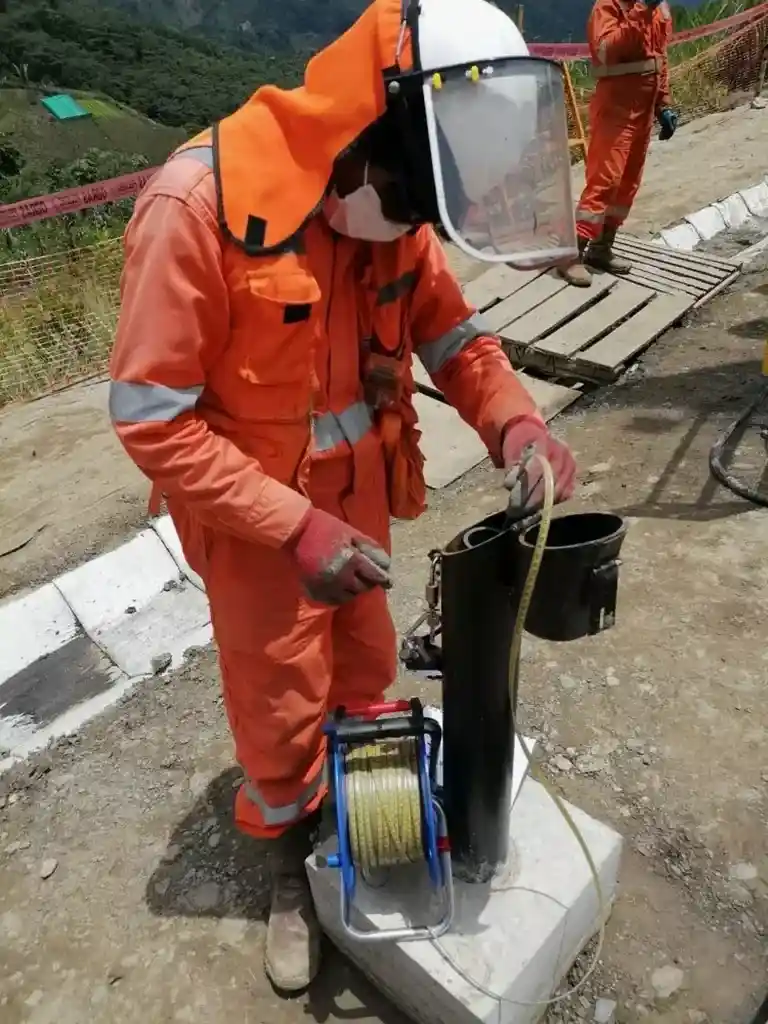
The scope is project-specific and guided by the CAN/BNQ 2501-250 standard. It generally involves a phased approach: a desktop review of geology and historical data, a site reconnaissance, and an intrusive field program. This program often combines exploratory test pits for shallow assessment with boreholes using SPT or CPT for deeper profiling, laboratory testing of recovered samples, and a final interpretive report with design recommendations.
The Saguenay region is underlain by Leda clay, a sensitive marine deposit from the Champlain Sea era. When undisturbed, it can be strong, but if remolded by a landslide or excavation, its structure collapses and it can flow like a liquid. This can trigger large retrogressive landslides, posing a severe risk to infrastructure and safety, making its identification and characterization a top priority for any investigation.
Geotechnical investigations in Saguenay are primarily governed by the Quebec Construction Code, which references the CAN/BNQ 2501-250 standard. This standard defines the requirements based on a building's importance category and site risk. All work must be supervised by an engineer licensed by the Ordre des ingénieurs du Québec (OIQ), who stamps the final geotechnical report, ensuring professional accountability and adherence to provincial law.
There is no single answer; the required depth is determined by the anticipated stress influence zone of the new structure and the soil conditions encountered. The investigation must extend through all compressible or weak layers into competent bearing strata. For a standard commercial building on sensitive clay, this often means drilling several meters into firm glacial till or bedrock, a depth confirmed by the supervising engineer based on real-time field observations and preliminary design loads.
We serve projects across Saguenay and its metropolitan area.