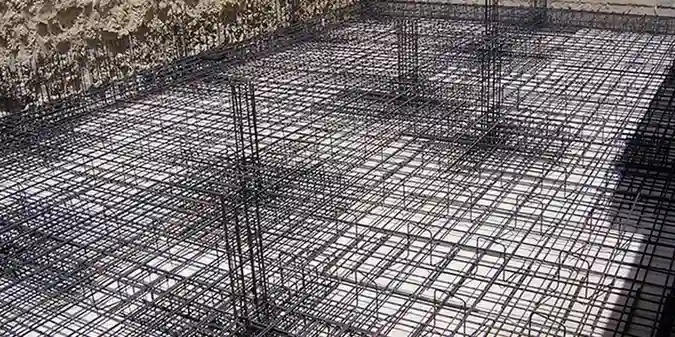
In Saguenay, we often see projects that look straightforward on paper turn into complex geotechnical puzzles once you break ground. The city, spread across Chicoutimi, Jonquière, and La Baie, sits on the Saguenay Graben, a geological structure that has left us with deep deposits of sensitive marine clay—locally known as “La Mer de Laflamme” sediments. What this means for your slab is that differential settlement isn't just a textbook risk; it's a daily reality we design against. Before finalizing a raft foundation layout, you will want to see how the CPT test profiles map out the crust thickness across your site, because in areas near the Rivière Saguenay, that crust can thin out abruptly, demanding a different approach than what works up on the terraces in the laterite-rich pockets of Jonquière.
In the Saguenay Graben, a mat foundation isn't just a slab—it's a structural bridge spanning the unpredictable pockets of sensitive clay left by the old Laflamme Sea.
How we work
Comparing two recent projects illustrates this perfectly. In the Shipshaw sector, we dealt with a dense glacial till over bedrock at about 3 meters, which meant the mat foundation was primarily designed for frost protection under NBCC 2015 guidelines, using a compacted granular pad beneath the slab. Just 15 kilometers east in La Baie, however, the soil profile was 12 meters of soft, high-plasticity silty clay with a sensitivity index that made any vibration a concern. The design there required a much stiffer raft, integrating closely-spaced ribs to bridge over potential weak zones. This is where combining a solid raft design with
stone columns as ground improvement makes practical sense, stiffening the upper stratum so the mat behaves as a true rigid body rather than flexing with every spring thaw. On larger commercial pads, we also tie in
in-situ permeability data to ensure the underslab drainage layer can handle the rapid snowmelt typical of a Saguenay spring, which often releases over 200 mm of water equivalent in a matter of weeks.
Local geotechnical context
The urban development of Saguenay took off after the 1996 flood, a disaster that reshaped both the city’s infrastructure and our understanding of local soil behavior. Many older buildings in the lower sectors of Chicoutimi were built on shallow footings that later experienced significant distress, not from the flood itself, but from the long-term saturation and subsequent leaching of the clay’s salt content, which reduced its shear strength. For a mat foundation, the biggest technical risk today is differential heave during freeze-thaw cycles. The Saguenay–Lac-Saint-Jean region sees over 140 days below freezing annually, and if the bearing stratum is heterogenous—say, a mix of compact till and pockets of frost-susceptible silt—the slab can lift unevenly by 30 to 50 mm. We mitigate this by deepening the perimeter beam and ensuring a minimum 300 mm of non-frost-susceptible granular fill, tested for fines content per ASTM D422, across the entire building footprint.
Regulatory framework
NBCC 2015, Division B, Part 4, CSA A23.3-14: Design of Concrete Structures, ASTM D2488: Description and Identification of Soils (Visual-Manual Procedure), ASTM D422: Standard Test Method for Particle-Size Analysis of Soils, ASTM D1586: Standard Test Method for Standard Penetration Test (SPT)
Questions and answers
What is the typical cost range for a raft foundation design on a residential lot in Saguenay?
For a standard residential project in sectors like Arvida or Chicoutimi-Nord, the geotechnical investigation and structural design package for a raft or mat foundation typically falls between CA$1,320 and CA$5,410, depending on site access and the required depth of clay investigation.
Why is frost protection more critical here than in other parts of Quebec?
Saguenay–Lac-Saint-Jean experiences deeper and more sustained frost than Montreal or Quebec City, with a design freezing index often exceeding 1,800 degree-days Celsius. The underlying silty clays are highly frost-susceptible, meaning without proper insulation and granular fill, a slab can heave significantly over a single winter.
Can you design a mat foundation on the sensitive clays found in La Baie?
We can. The approach relies on maintaining a competent desiccated crust as the bearing layer and using a structurally stiff raft to span any localized soft zones. We also specify low-vibration excavation methods and immediate concrete blinding to prevent moisture change in the exposed clay, which could trigger a loss of strength.
How long does the design process take from site investigation to stamped drawings?
A typical timeline is three to four weeks after the field work is complete. The first week focuses on lab testing of the clay samples, particularly consolidation and Atterberg limits. The remaining time is spent on iterative structural modeling to optimize slab thickness and reinforcement for the specific subgrade modulus we measure on your site.